Sunday, March 29, 2026
Validate Demand in 2026 With a 14-Day PDP 3D Test
Most validation advice is backwards: you don’t validate the product, you validate the page
If you’re a Reddit marketer or SaaS founder, you’ve seen the same loop: someone spends months building, ships, then discovers demand was imaginary. The “validate first” mantra is right, but most execution is wrong.
In e-commerce, demand often isn’t about the product existing. It’s about whether the product page answers doubts fast enough to get a purchase without a support ticket, a return, or a chargeback. And roughly 90% of consumers say product page quality influences their purchase decisions. [Pagepilot]
So if you’re considering interactive 3D/rotation on your PDPs, the question isn’t “Should we build 3D?” The question is “Does 3D reduce uncertainty enough to move conversion and reduce post-purchase pain?” That’s measurable in two weeks on a subset of SKUs.
This matters because 42% of startups fail due to lack of market demand. [Createanmvp] The fastest way to avoid that isn’t a 30-slide strategy deck. It’s a controlled experiment on the surface area where customers decide.
The 14-day Shopify product page test: the core experiment (no rebuild required)
Here’s the playbook we use internally when we’re skeptical about a PDP change. It’s designed to answer one thing: is this improvement real, or just a nicer-looking page?
Step 1: Pick SKUs where 3D should matter (and where it won’t)
- Start with 10–30 SKUs that have visual ambiguity: reflective materials, texture, fit, moving parts, scale issues (e.g., bags, shoes, furniture, electronics accessories).
- Exclude “commodity” SKUs where buyers already know what they’re getting (refills, basics, replacement parts) unless returns are high.
- If you have variants, pick one hero variant per SKU to avoid muddy data.
Step 2: Define control vs treatment like you mean it
The control is your current PDP media stack. The treatment is the same PDP, same copy, same price, same offer—only the media block changes (interactive rotation/3D added, ideally above the fold).
If you change three things at once, you didn’t run an experiment. You made a redesign and hoped.
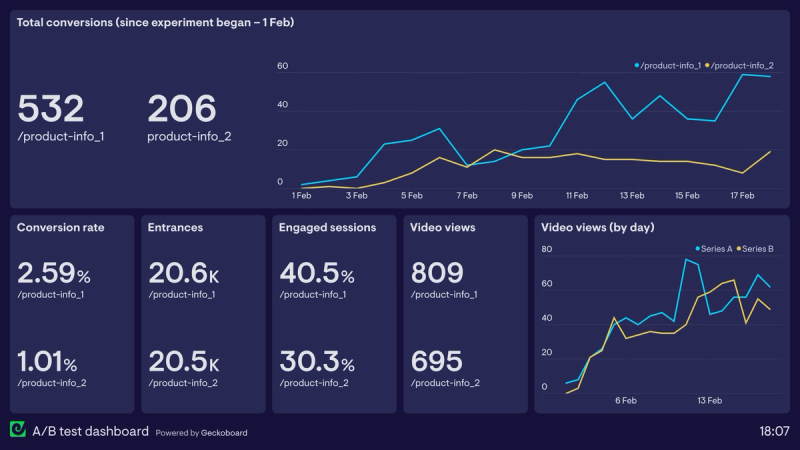
Step 3: Run it for 14 days, not “until it feels significant”
Two weeks is long enough to capture weekday/weekend behavior and short enough to keep you honest. It also reduces the temptation to keep tweaking mid-test, which invalidates results.
A/B testing is already standard practice for Shopify optimization, because it’s the cleanest way to isolate what actually improves conversion. [Getshogun]
Success metrics that founders actually care about (not vanity engagement)
Most “conversion rate experiment ideas” lists obsess over clicky metrics. For PDP 3D, you need a mix: one metric that pays you now, and two that reduce pain later.
Primary metric (pays you now)
- Add-to-cart rate (ATC) on tested PDPs
- Purchase conversion rate from PDP view → purchase
- Revenue per session (RPS) for sessions that hit tested PDPs
Secondary metrics (reduce returns, support load, and chargeback risk)
- Return-rate proxy: “Where is my order / not as expected” ticket rate per 100 orders (track tags in your helpdesk).
- Pre-purchase support: product questions per 1,000 PDP views (size/fit, materials, dimensions).
- Refund reasons: % attributed to “not as described” (use consistent reason codes).
This is where the skeptical founder brain should go: returns and disputes are often a mismatch between what the customer thought they bought and what arrived. The phrase you’ll see in the wild is “service not as described” or “not as described,” and it’s brutal because it shifts the burden of proof onto you.
If your product presentation reduces ambiguity, you’re not just chasing conversion lift. You’re buying down operational risk.
The MVP validation checklist (SKU-level) for PDP 3D in 2026
An MVP isn’t “the smallest version of your dream.” It’s the smallest test that answers the question you’re afraid of. MVP thinking is explicitly about testing core value without heavy investment. [Darosoft]
Use this checklist before you spend a sprint integrating anything.
- Hypothesis: Write one sentence. Example: “Adding interactive rotation to SKU set A will increase PDP→purchase conversion by 10% relative and reduce ‘not as described’ refunds.”
- Instrumentation: Ensure you can segment by SKU and variant (control vs treatment) in analytics.
- Traffic: Confirm the SKU set gets enough sessions to learn something in 14 days. If not, expand SKU count or extend test length.
- Consistency: Freeze price, discounting, and shipping offers for the test SKUs during the 14 days.
- Support tagging: Add 3–5 standardized tags for tickets: “dimensions,” “materials,” “color mismatch,” “how it works,” “returns-not-as-expected.”
- Dispute readiness: Store proof artifacts (PDP snapshots, order confirmation, shipping, customer comms) per order for at least 12 months if you sell subscriptions/annual plans.
That last line looks weird in a “PDP 3D” post, but it’s the same muscle: evidence. If you ever get a dispute 10–11 months later, you don’t want to reconstruct what the customer saw. You want to pull it up.
Stop/scale rubric: how to decide in week 2 without lying to yourself
Founders love to say they’re data-driven. Then they see a small lift and declare victory. Or they see noise and keep running the test forever.
Use a rubric. It keeps you from rationalizing.
Scale criteria (any 2 = scale to more SKUs)
- Conversion: +5–15% relative lift in PDP→purchase conversion on treatment SKUs (directionally consistent across most SKUs).
- Support: ≥10% drop in pre-purchase product questions per 1,000 PDP views.
- Refund reasons: noticeable shift away from “not as described / not as expected” reasons on tested SKUs (even if absolute returns take longer to settle).
Stop criteria (any 1 = pause and diagnose)
- Conversion flat or down across most SKUs (not just one outlier).
- Page performance regressions: slower load or media glitches on mobile.
- More confusion: support tickets increase, especially “how does this work” or “is this legit.”
Notice what isn’t in the rubric: “time on page.” Engagement is nice, but it’s not the goal. The goal is fewer doubts and more completed orders.
Build vs buy e-commerce tools: what you’re really choosing
“Build vs buy” gets framed as cost. That’s not the real trade. The real trade is: do you want to spend engineering cycles on a differentiator, or on plumbing you’ll maintain forever?
When building is rational
- You need a proprietary viewer or interaction model tied to your product (e.g., configurators with complex rules).
- You have in-house 3D pipeline expertise and can support it long-term.
- Your brand positioning requires full control over media hosting, privacy, and compliance.
When buying is rational
- You’re validating whether interactive media moves conversion at all.
- You want to test on 10–30 SKUs without a quarter-long roadmap item.
- You’d rather invest in merchandising, creative, and offer strategy than maintaining a renderer.
We built RotateProduct because most stores don’t need a full 3D production studio to learn if 3D helps. They need a fast way to turn existing product photos into an interactive 3D-like rotation experience, then measure the impact SKU by SKU.
That said, the tool choice is secondary. The experiment design is the thing. If you can’t measure it, you can’t validate it.
Trust, privacy, and compliance: why “interactive” can backfire in 2026
Customers are jumpy now. They assume tracking. They assume dark patterns. And regulators are paying more attention to deceptive practices.
If your interactive media loads from sketchy third-party servers, adds aggressive trackers, or behaves oddly on mobile, you can create the exact opposite of what you wanted: less trust, more hesitation, more tickets.
Practical safeguards (do these before you scale)
- Performance budget: set a max added load time for the treatment variant and measure it on mobile.
- Disclosure: don’t imply “true 3D scan” if it’s not. Avoid anything that could be interpreted as deceptive.
- Data minimization: don’t collect extra user data just because you can. If you don’t need it for the experiment, don’t store it.
This is also a brand decision. Some brands are taking public stances against certain AI uses to signal authenticity. Whether you agree or not, the takeaway is real: trust is a conversion lever now.
How to validate business idea fast if you’re a SaaS founder (using e-commerce thinking)
SaaS founders reading this might think, “Cool for Shopify, but I’m not selling a hoodie.” The pattern still applies: validate the decision surface, not the full product.
Lean validation methods—landing pages, surveys, customer interviews—are common because they reduce wasted build time. [Swordpowergm] The upgrade in 2026 is making those tests closer to the real purchase decision.
Translate the PDP test into SaaS terms
- PDP = pricing page + one core use-case page
- 3D interaction = interactive demo / product tour / sandbox
- ATC = start trial / request access
- Refund reasons = churn reasons / chargebacks / “not as described” disputes
A 14-day SaaS equivalent experiment
- Pick one ICP and one use case (don’t test across three personas).
- Control: current static page. Treatment: interactive demo that answers the top 3 objections.
- Success metrics: trial-start rate, activation rate (within 24–48 hours), and support tickets per 100 signups.
- Stop/scale rubric: scale only if trial-start and activation move together (trial-start alone can be low-intent).
This is how you avoid the “burned years building things nobody wanted” story. Not by being smarter. By being stricter about what counts as proof.
A concrete Shopify workflow we see work: 30 SKUs, one theme section, one dashboard
If you want a practical implementation path, this is the one we recommend because it stays reversible.
- Create a SKU shortlist (30 max) and tag products in Shopify (e.g., tag: “pdp-3d-test”).
- Add one media block/section in your theme that can be toggled by product tag (control vs treatment).
- Randomize exposure: if you have an A/B testing tool, split traffic 50/50. If you don’t, split by SKU set (15 control SKUs, 15 treatment SKUs) and keep everything else identical.
- Track events: PDP views, ATC, checkout start, purchase. Segment by SKU and variant.
- Create a simple sheet: one row per SKU with baseline conversion, test conversion, and notes from support tickets.
- At day 14, apply the stop/scale rubric. Scale to the next 50–100 SKUs only if you pass.
This is also the cleanest way to keep your ops sane. If the test fails, you remove one section and move on. No sunk-cost architecture.
Where this goes wrong: common failure modes I keep seeing
If you’ve run experiments before, you already know the enemy isn’t lack of ideas. It’s sloppy execution.
- Testing during a promo: you can’t attribute lift if you changed discounting mid-test.
- Choosing the wrong SKUs: 3D won’t save a product with weak positioning or pricing.
- Ignoring mobile: interactive media that’s smooth on desktop but janky on mobile will quietly kill conversion.
- Measuring only conversion: you miss the operational upside (support + returns), which is often the real ROI.
- Overfitting to one winner SKU: you scale based on an outlier and get disappointed.
The fix is boring: define the hypothesis, isolate the variable, run it long enough, and decide using a rubric. Boring is good. Boring ships.
If you want more background on why CRO changes can materially move revenue, Shopify-focused CRO case studies often show meaningful gains from product page redesigns and UX improvements. [Theecommerceboutique]
And if you’re thinking bigger-picture about platform and operational scalability, Shopify’s enterprise case studies are a reminder that optimization work compounds when your stack is stable. [Shopify]
That’s the real point: validate the lever first, then invest.
Inline CTA: If you want to run this exact 14-day PDP rotation test without building a 3D pipeline, RotateProduct is one option—turn existing photos into an interactive 3D experience and measure it SKU-by-SKU.
Frequently Asked Questions
How fast can I validate a business idea in 2026 without building the full product?
Aim for a 14-day experiment on the decision surface (PDP/pricing page) with one variable changed and clear success metrics. Lean validation methods like landing pages and interviews are still useful, but the key is tying them to measurable conversion behavior. [Swordpowergm]
What should be on an MVP validation checklist for a Shopify product page test?
At minimum: a one-sentence hypothesis, control vs treatment definition, analytics segmentation by SKU/variant, a 14-day fixed window, frozen offers/pricing, and a stop/scale rubric. MVPs exist to validate core value with minimal build. [Darosoft]
What conversion rate experiment ideas pair best with interactive 3D/rotation on PDPs?
Test one change at a time: (1) 3D media above the fold vs below, (2) default view angle, (3) variant selection UX next to the viewer, (4) adding a short “what you’re seeing” caption to reduce confusion. Use A/B testing to isolate impact. [Getshogun]
How do I avoid trust and compliance issues when adding interactive media?
Keep it honest (no misleading claims), minimize tracking, and watch performance—especially on mobile. Product page quality heavily influences buying decisions, so anything that feels sketchy or slow can hurt conversion. [Pagepilot]
Should I build or buy e-commerce tools for PDP 3D?
Buy to validate quickly and keep the test reversible; build only if interactive media is a core differentiator you’ll maintain long-term. The point is to prove lift before committing engineering time—because lack of demand is a top failure mode. [Createanmvp]